AI Voice Agents Boost Electricians' Job Efficiency
Contractors, Electricians, AI voice agent, Missed calls, Lead follow-up, Electrical contractor automation
How AI Voice Agents Help Electricians Stop Losing Jobs to Missed Calls
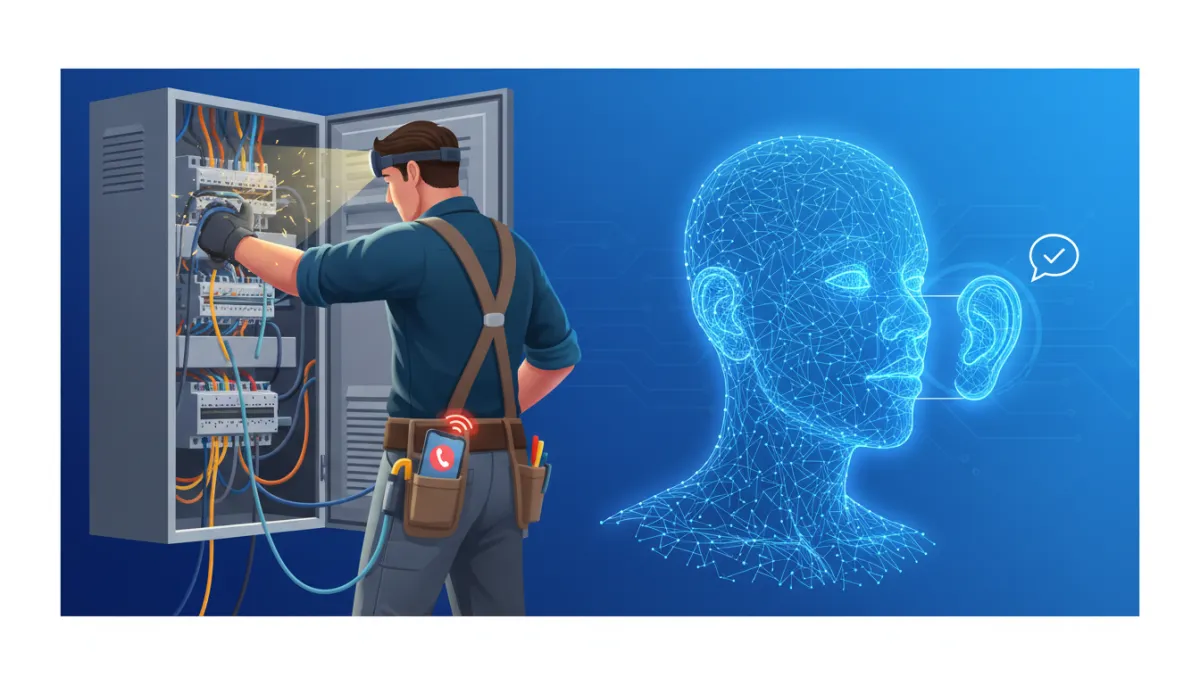
You are elbow-deep in a live electrical panel, tracing a fault that keeps tripping a main breaker. Gloves on, tools out, customer watching. At that exact moment, your phone starts ringing in your pocket. You hear it, but there is no safe way to stop what you are doing, climb down, and answer. By the time you wrap up, clean up, and call back, the homeowner has already booked the next electrician on their list. The work did not go to the better electrician. It went to the one who answered first. This is not a failure of work ethic. It is a structural problem built into electrical contracting, and it is a problem that smart AI call handling can now solve.
The Phone Problem Electricians Cannot Solve by Working Harder
Most small electrical contractors carry the business phone themselves. On a typical day you are driving, hauling ladders, inside crawl spaces, or working live. You cannot safely pick up every call, no matter how motivated you are. There is a hard limit on what one person can do with one phone and two hands.
Industry studies on service businesses show that a large share of calls come in while crews are actively on jobs, which is exactly when electricians are least able to answer. Add in noise from saws, vacuums, or generators, and even calls you want to take are easy to miss. It is not uncommon for busy trades to miss 20 to 30 percent of incoming calls on heavy workdays, especially when there is no dedicated office staff.
The problem gets worse after hours. Homeowners often notice issues in the evening when they flip on lights, turn on appliances, or smell something that does not seem right. Many small shops have no coverage at all after 5 p.m. or on weekends. Every one of those calls that rolls to voicemail is a potential panel upgrade, service call, or emergency job that may go straight to a competitor who picked up first. You cannot simply work harder to fix this. You need a different way to handle the phone.
Why Voicemail Is Not a Safety Net
Many electricians assume that voicemail covers them. The caller will leave a message, the thinking goes, and you will call back when you get a break. In reality, voicemail is where a large share of leads quietly die. Most homeowners who reach voicemail never leave a message. They simply hang up and dial the next electrician on Google or the list their friend sent them.
Put yourself in their shoes. The lights are flickering, the panel is warm to the touch, or there is a burning smell near an outlet. They are worried about safety and want someone to respond now. A generic greeting that asks them to leave a message does not feel like help. It feels like a delay. By the time you return the call at lunch or at the end of the day, they have already talked with another contractor and likely booked the job.
Research on lead response time across service businesses is clear. Teams that respond within minutes convert dramatically more leads than those that respond hours later. Some studies show that contacting a new lead within five minutes can produce several times more conversions than waiting even an hour. The first business to respond in a meaningful way usually wins the job. Voicemail does not help you be first. It simply records proof that you were too late.
What an AI Voice Agent Actually Does on a Service Call
An AI voice agent is not a robot voice reading a script. It is a phone system that answers every call instantly, speaks in a natural tone, and follows a process you define for your electrical business. Think of it as a highly trained virtual receptionist that never gets tired and never lets a call ring out or fall to voicemail.
When a homeowner calls, the AI voice agent picks up on the first ring. It greets them with your company name and a professional introduction. Then it asks clear, simple questions. It collects their name, phone number, service address, and a brief description of the issue. It confirms how urgent the situation feels and what time windows work for them. The conversation feels like talking to a well trained office coordinator who knows how your schedule works and what kind of jobs you take.
For emergencies, the system listens for phrases like “burning smell,” “sparking,” “no power,” or “half the house is out.” When it hears those red flag words, it follows an escalation path you approve. That might mean calling or texting the on call electrician, sending a high priority alert, or routing the call to a live person immediately. The caller feels heard and taken seriously instead of being left with a voicemail box.
For routine work, the AI voice agent can check your calendar rules and book appointments directly. It can offer time windows you have pre approved, such as “tomorrow between 10 and 12” or “Thursday afternoon.” Once the caller confirms, you receive a text or email with all the details, including the notes about the issue. The customer receives a confirmation and often a reminder as well. There is no voicemail to return, no phone tag, and no lead slipping away while you are on a ladder.
Automated Follow-Up Closes the Gap for Web and Text Inquiries
Not every lead comes in by phone. Many homeowners fill out a contact form on your website, send a text, or click a “request a quote” button from a directory listing. These leads are easy to lose. Messages get buried under job photos and supplier texts. Someone means to reply later and never does. The result is the same as a missed call. Another contractor responds first and wins the work.
Automated follow-up sequences close this gap. When a new web form or text inquiry arrives, the system sends a personalized reply within seconds. The message can introduce your company, ask a couple of key questions, and offer a link or prompt to schedule a visit. If the prospect does not respond, a polite follow-up goes out the next day, and another shortly after that. You set the tone and timing once, then the system runs it consistently for every lead.
Text based follow-up is especially effective for electricians. SMS messages are opened and read at far higher rates than email, and they fit the way homeowners already communicate. Instead of chasing every inquiry manually, you let automation keep the conversation alive until the homeowner is ready to book. You stay focused on panels and wiring while the system quietly handles lead follow-up in the background.
The Outcome: More Jobs Booked from the Same Call Volume
When AI voice agents and automated follow-up are in place, the number of calls you receive does not need to change for your booked jobs to increase. The difference is in how many of those calls and messages actually turn into scheduled work. More of the leads you already paid for through marketing or word of mouth stay with you instead of drifting to competitors.
After-hours calls that used to roll to voicemail now get answered instantly, with appointments set for the next available slot. Midday calls that used to be missed while you were in an attic or crawl space are handled professionally, with clear notes and confirmed time windows. The crew can stay focused on doing safe, high quality work without stopping every 10 minutes to check the phone or return messages in the truck between jobs.
Customers notice the difference. Instead of hearing a voicemail greeting, they speak with a responsive, organized system that treats their issue as important. That experience builds trust before you even arrive on site. While every market is different and no tool can guarantee specific revenue numbers, it is common for contractors to see a meaningful lift in booked work simply by capturing more of the leads they already generate.
A Practical First Step
You do not need to rebuild your entire operation to start using AI call handling. A simple first move is to audit how your phone and messages work today. For one or two typical weeks, track three numbers. How many calls come in? How many go unanswered or to voicemail? What is your average job value for a service call or small project?
Even rough numbers are helpful. If you see that you miss several calls a week and each booked job is worth a few hundred dollars or more, it becomes clear how expensive those missed calls really are. From there, comparing that lost opportunity to the cost of an AI voice agent and automated follow-up is straightforward. In many cases, a modest monthly investment can pay for itself with a single recovered job.
The goal is not to add complexity. It is to build a simple, reliable system that keeps your phone covered while you stay on the tools. Once that foundation is in place, you can refine scripts, adjust escalation rules, and tune your follow-up timing based on what works best in your market.
Conclusion: Let AI Cover the Phone So You Can Focus on the Work
Electricians are skilled professionals. Your value is in diagnosing problems, installing safely, and standing behind your work, not in racing to every ringing phone. The reality is that you cannot be in two places at once. Trying to wire a panel and act as a full time receptionist at the same time is a recipe for stress and missed opportunity.
AI voice agents and automated lead follow-up offer a practical way to run a responsive, professional operation without adding headcount. Every caller gets an immediate answer. Every web or text inquiry gets a timely reply. You and your team stay focused on safe, profitable work while the system quietly protects your pipeline of new jobs.
If you want to explore how this could fit your specific electrical business, you can schedule a strategy call with Rex Madden CPA. The goal is to look at your numbers, your call patterns, and your market, then decide together whether AI powered call handling makes sense as your next step. This article is a draft for your consideration and is not published.
FAQ
Q1: Can an AI voice agent handle electrical emergency calls appropriately?
Yes, when it is set up correctly. You define what counts as an emergency for your shop. The AI voice agent listens for specific words and phrases that signal risk, such as “burning smell,” “sparks,” “no power to half the house,” or “breaker keeps tripping.” When it hears those, it follows a clear escalation plan, such as calling the on call electrician, sending priority alerts, or routing the caller to a live person. You keep control over the rules so emergencies are treated with the urgency they deserve.
Q2: Will callers know they are speaking with an AI?
In many cases, callers simply experience it as a helpful, professional receptionist. The voice is natural and the questions are straightforward. If you prefer full transparency, the greeting can clearly state that they are speaking with your virtual assistant. The important part for most homeowners is not whether the agent is human. It is that someone answers right away, listens carefully, and gets them scheduled quickly.
Q3: Do I need to replace my current phone system to use this?
Usually not. Most AI voice agent solutions can integrate with existing phone numbers and call routing. In practice, your main business line is forwarded to the AI agent, either all the time or only during certain hours. You keep your number, your branding, and your call history. The setup is typically handled behind the scenes so there is little disruption to your day to day work.
Q4: What happens if a customer asks something the AI cannot answer?
Good systems are designed with safe limits. If the caller asks a technical question or a pricing question outside the script, the AI voice agent can respond with a simple explanation that a licensed electrician will follow up. It then captures the question in its notes and flags the call for you to review. The goal is not to replace your expertise. It is to gather accurate information, keep the customer engaged, and make sure you know exactly what needs a human response.
Q5: How quickly can an AI call handling system be up and running?
Implementation is usually measured in days, not months. Once you have your call scripts, escalation rules, and scheduling preferences defined, the technical setup can often be completed within a short window. There is some fine tuning in the first few weeks as you see real calls come through and adjust wording or routing. For most small electrical contractors, the transition can be planned so it does not interrupt current jobs while still delivering faster, more consistent call coverage.
URL Slug: electricians-ai-voice-agent-missed-calls
SEO Title: How AI Helps Electricians Stop Losing Leads to Missed Calls
Meta Description: Electricians miss calls on every job site. Learn how AI voice agents and automated follow-up can capture more leads and book more jobs without extra staff.
Category: Contractors
Tags: electricians, AI voice agent, missed calls, lead follow-up, home services automation
Author: Rex Madden